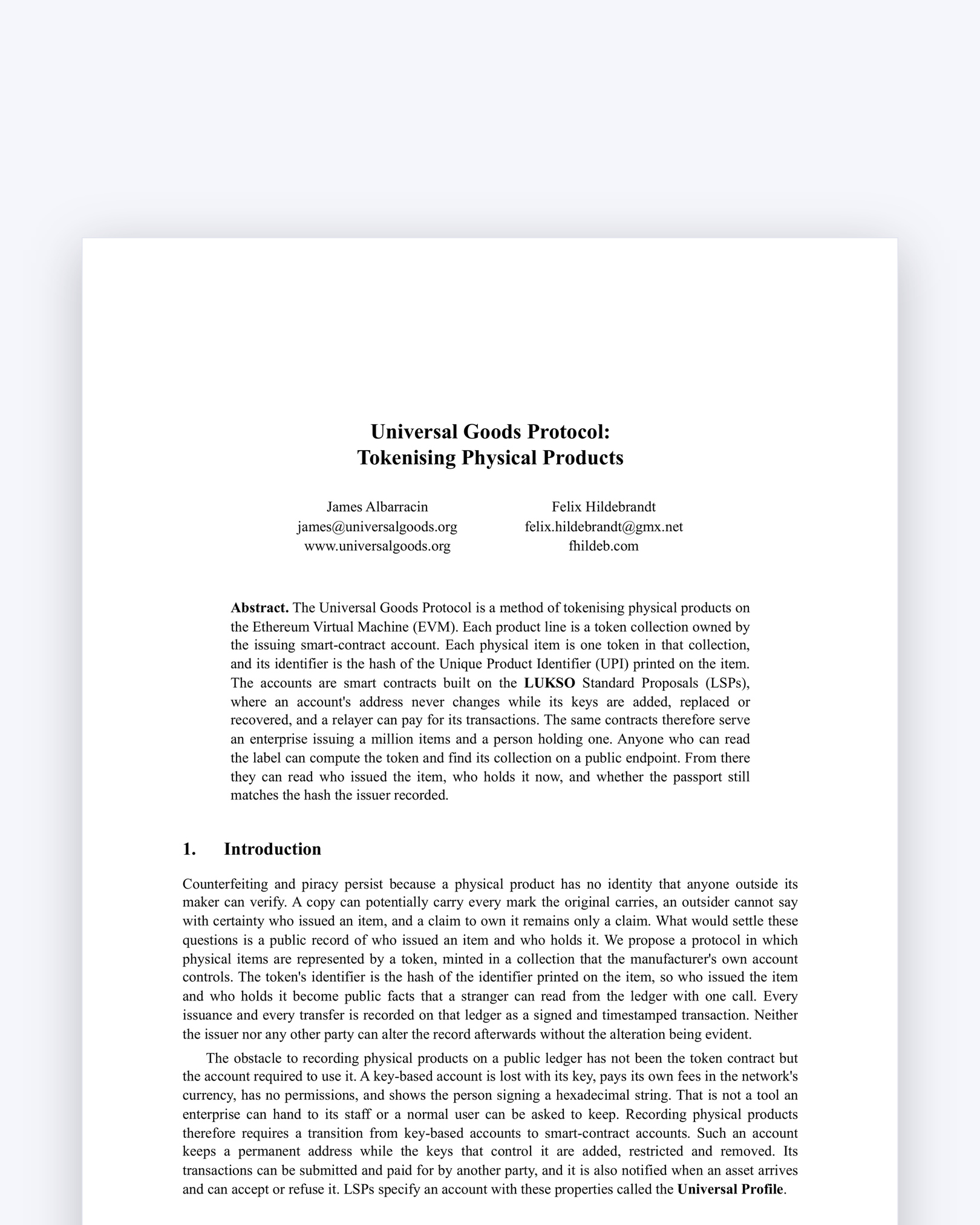
Counterfeiting and piracy have long plagued global commerce, at an estimated cost to the world of $2.3 trillion a year. That estimate comes from research prepared for the International Chamber of Commerce and the International Trademark Association. The problem persists for a simple reason: a physical product has no identity that anyone outside its maker can verify. A copy can carry every mark the original carries, an outsider cannot say with certainty who issued an item, and a claim to own it remains only a claim.
We are now proposing a solution. The Universal Goods Protocol whitepaper sets out a method of tokenising physical products on a decentralised blockchain, so that who issued an item and who holds it become public facts anyone can check. Two things make this possible now: recent advances in the technology, and the regulatory mandate of the EU's Digital Product Passport. This article is the short version. The full 12-page paper is available below.
Why now
The first change is technological. Recording physical products on a public ledger has been held back not by the token contract but by the account required to use it. A key-based account is lost with its key, pays its own fees in the network's currency, and shows the person signing a hexadecimal string. That is not a tool an enterprise can hand to its staff, or one a normal user can be asked to keep. The latest smart-contract standards, the LUKSO Standard Proposals, replace it with an account whose address never changes while its keys are added, restricted, replaced or recovered, and whose transactions a relayer can submit and pay for. The same contracts therefore serve an enterprise issuing a million items and a person holding one.
The second change is regulatory. The EU's Ecodesign for Sustainable Products Regulation makes a Digital Product Passport mandatory for products sold in the EU, phased in by product category. A scannable identifier that leads to a digital record is becoming a legal requirement. The protocol builds on that mandate. It uses the same GS1 identifiers and follows the European standards for how a passport is delivered, and it adds what a passport alone does not provide: a public record of who issued the item and who holds it.
One printed identifier, one token
Under the protocol, each product line is a token collection owned by the manufacturer's own account, and each physical item is one token in that collection. The token's identifier is the hash of the Unique Product Identifier printed on the item: a GS1 Digital Link carrying the product's GTIN and an item-level serial. Anyone who can read the label can compute the token, find its collection on a public endpoint, and read the rest from the ledger.
Applied to a physical item, this provides three properties that a copied item cannot reproduce:
- One identifier, one token. Each printed identifier names exactly one token in a collection, and a second mint of it is rejected.
- Issuance is attributable. Only a collection's owner can mint into it, so every token carries the account that issued it.
- Ownership is public. Anyone can read the current holder of a token with a single call, and its history from mint to present holder is fixed on the ledger with a timestamp at every step.
A token moves only when its holder offers it and the receiver accepts it. Ownership of this kind is non-custodial by construction: the issuer holds nothing for anyone else, and a person who accepts a token holds it in an account only their own keys control.
Why a copied label fails
The identifier is carried on the item as a QR Code or Data Matrix, or written to an NFC or RFID tag. It is publicly visible and can be scanned by anyone, and the integrity of the record does not depend on it being hidden. A copied identifier on a counterfeit resolves to the genuine item's record, whose token lives in the brand's collection and is held by whoever the ledger says. A counterfeiter cannot mint a second token for the same identifier, cannot change the holder, and cannot write to the record.
“What makes an item authentic in the protocol's sense is therefore not the identifier but the ownership and provenance behind it.”
— Universal Goods Protocol whitepaper, section 4
Verification without trusting the seller
A third party cannot be asked to trust a company's database about that company's products, and a seller cannot be allowed to choose the verifier. Verification under the protocol therefore reads the public ledger through an endpoint the reader chose, starting from nothing but the printed identifier. In five steps a reader obtains the identifier, derives the token, locates its mint, confirms the issuer from the issuer's own account, and retrieves the current holder. A second procedure confirms that the content of the product passport has not changed since the issuer committed to it.
What our research concluded
Commerce is becoming agentic, with AI models choosing products on behalf of buyers, so we tested how those models read and act on these records in pre-registered studies. Asked by a shopper to choose between two matched batteries on live shop pages, three models recommended the product that carried a passport in 81% of trials, against 39% when neither product carried one. Against a rival with a fake passport, that advantage vanished. AI readers reward a convincing fake equally when verification takes more than one step.
Verification is where the public ledger matters. When the same models were given the protocol's verification procedure as a tool they could call, they recommended the genuine product in 89% of trials, against 33% without it, and no model chose the fake after the tool reported that no record existed for it. A record on a decentralised public ledger can be checked by any person or machine with one call. A record in a privately operated database cannot be checked this way without trusting its operator.
Our conclusion from this research and development is that tokenising a product on a decentralised blockchain improves both the recommendation and the verification of a physical product by an AI model.
Beyond the first sale
Tokenising a product also changes the commercial position of the manufacturer. Today a manufacturer's relationship with its product ends at the first sale. Under the protocol every item has a holder of record, so warranty, recall, service and resale follow the item rather than the receipt. Because the record is public and built on open standards, lenders, insurers and resale platforms can read and act on it without an account with the issuer or its approval.
What the protocol does not do
The paper is explicit about its limits. The protocol makes an assertion attributable, tamper-evident and portable. It does not make it true: a false value committed with a valid key remains false, and the protocol records only who committed it and when. Presenting an identifier does not prove possession of the item, because anyone who has seen the label can present it. Every transfer permanently records the accounts of both parties, so the protocol writes no passport content to the ledger, only identifiers, authorisations and hashes. And because the web host in the identifier is part of the hash, an issuer should ensure that host remains available beyond the life of its products.
James Albarracin is the Founder & CEO of Family Labs, the company behind the Universal Goods Protocol. Felix Hildebrandt is co-author of the Universal Goods Protocol whitepaper.