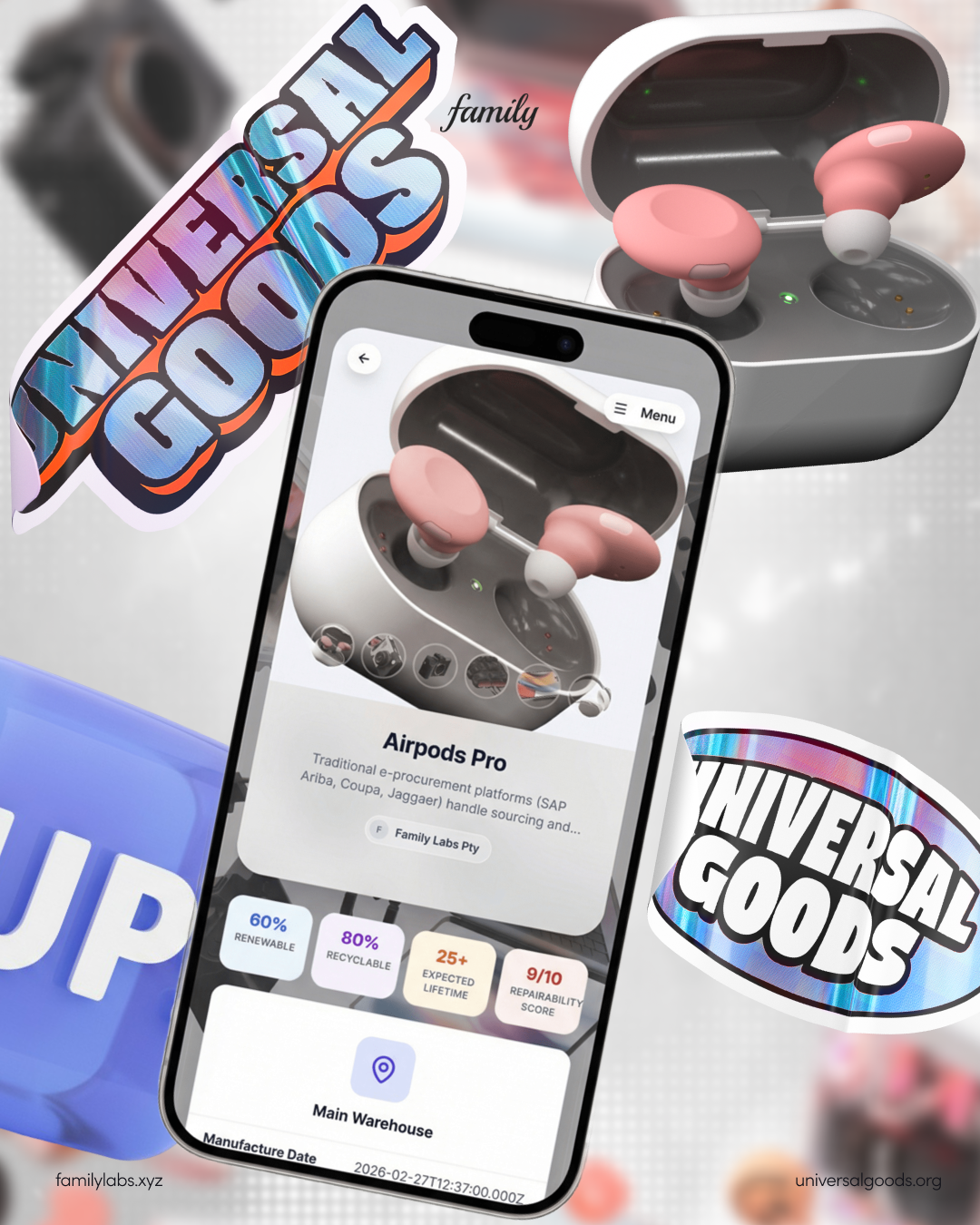
The Universal Goods Protocol is open infrastructure that tokenises physical products into programmable digital assets. The simplest way to understand it is by analogy. Email needed SMTP. The web needed TCP/IP. Physical commerce needs a shared, compliant, and open standard for product identity, and until now it has never had one.
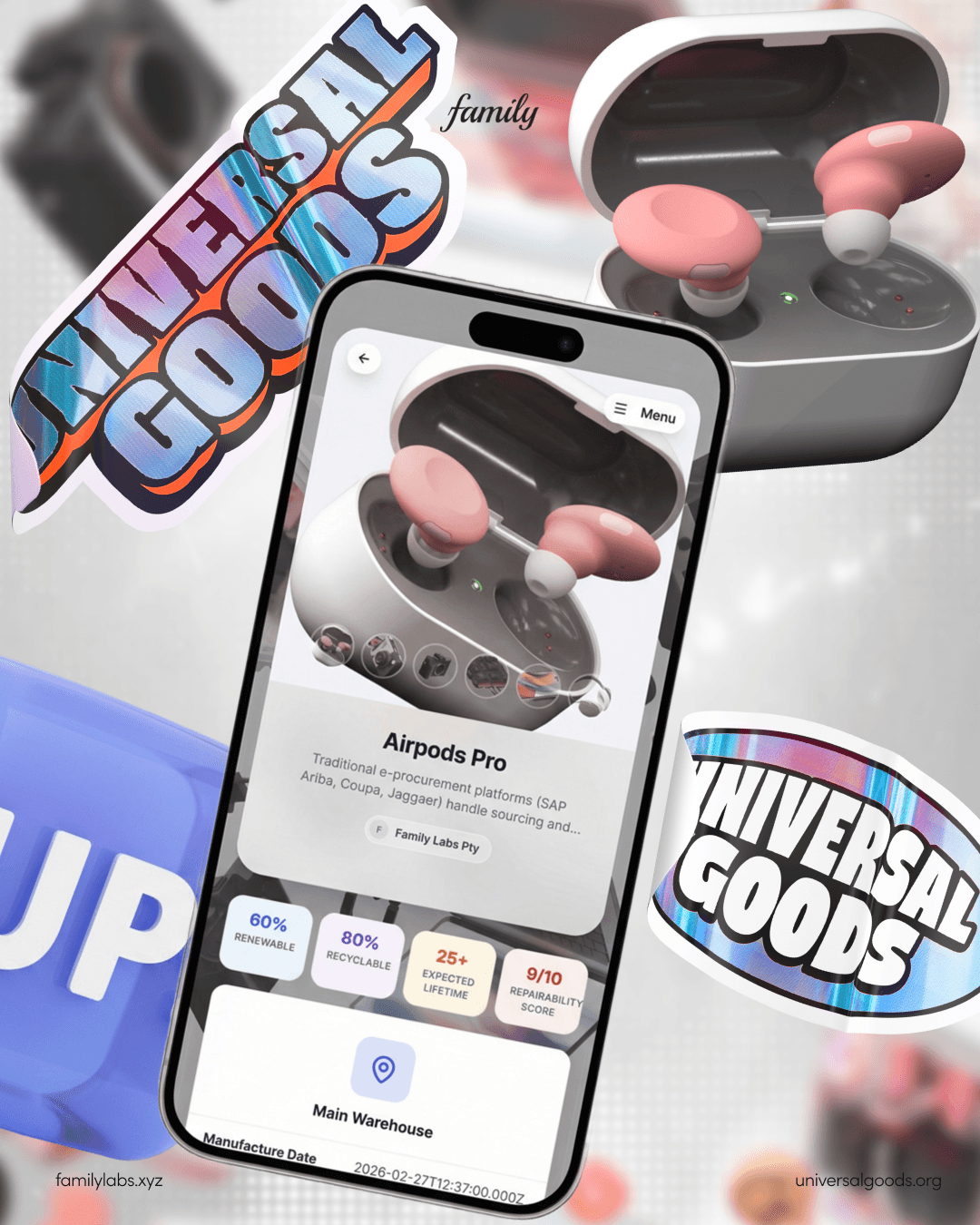
An open standard anyone can build on
Physical commerce needs a product-identity layer that any participant can build on without asking permission:
- Brands.
- Consumers.
- Recyclers and repairers.
- AI agents.
- Regulators.
Permissionless access is the whole point. The layers that became universal, like SMTP and TCP/IP, won precisely because no single company controlled who was allowed to use them. A product-identity standard has to clear the same bar.
That identity is a Digital Product Passport
In the Universal Goods Protocol, a product's identity takes the form of a Digital Product Passport. Each passport carries the full record of the object:
- Origin.
- Materials.
- Compliance data.
- Repairability.
- End-of-life instructions.
- Provenance.
Protocol and Platform: two layers, one system
There are two layers to what we are building, and the distinction matters. The Universal Goods Protocol is the open infrastructure. Because of its systemic importance to society, it will eventually transition from our centralised control into a shared public good. A record of what billions of people own should not belong to one company forever.
The Universal Goods Platform is the commercial layer we built on top: the AI-native operator that helps brands and enterprises actually deliver compliant passports at scale. The protocol is the open standard. The platform is how an enterprise puts it to work today.
Five years ago this was a hard sell. Today it is inevitable.
The European Union's Ecodesign for Sustainable Products Regulation (ESPR) is now in force. It mandates Digital Product Passports across numerous product categories, phasing in from 2026 through 2030:
- Textiles.
- Electronics.
- Furniture.
- Batteries.
- Apparel.
Brands that cannot produce a compliant passport face penalties, or lose the ability to sell into the EU at all. Roughly 12.4 billion products a year fall under this regulation. The question is no longer whether physical products will need digital identities. It is who will provide the infrastructure when they do.
But compliance is not the whole story
Compliance is the trigger, not the prize. Soon every physical product will have a Digital Product Passport, and the passport itself will become a commodity. At that point the passport is table stakes, and the advantage shifts entirely to what you can actually do with it.
“Soon every physical product will have a Digital Product Passport. The question that matters is what you can actually do with it.”
Why the Universal Goods Protocol wins
Beyond the mandate, the protocol delivers operational and financial value a brand can measure:
- It tokenises compliant Digital Product Passports.
- It opens a new revenue stream through secondary-market royalties, earned as a second-order effect of every resale.
- It saves brands 2-3% annually on cross-border supply-chain transactions using stablecoins.
- It is becoming an agentic platform (coming soon).
- It is built for interoperability with AI (coming soon).
Real operational and financial value, not compliance alone, is the key to adoption. The mandate gets a brand to the table. The economics are what keep it there. That is the bet behind the Universal Goods Protocol: build the open standard the world is about to require, and make it worth using for reasons that have nothing to do with the regulation at all.
James Albarracin is the Founder & CEO of Family Labs, the company behind the Universal Goods Protocol, open infrastructure that tokenises physical products into programmable digital assets via EU-compliant Digital Product Passports.